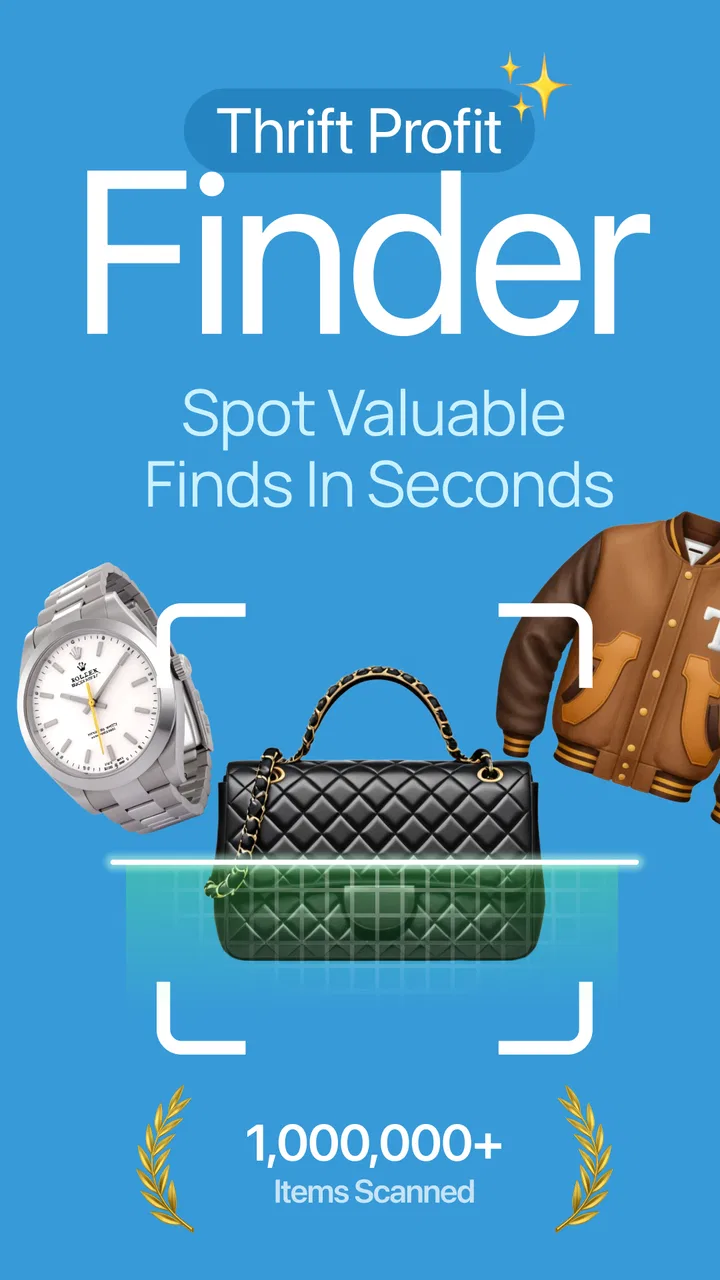
Thrift & Profit Finder - Gemli
- 4.7
- Rating
- 100.00K
- Installs
- Free
- Price

 Analysis by App-foxy
I like thrift shopping because the best finds are rarely obvious. A plain-looking jacket, lamp, or pair of shoes can be worth very little—or surprisingly more than its price suggests. Thrift & Profit Finder - Gemli is built around that moment of uncertainty. It is a lifestyle app from 326 LAB - FZCO that uses AI to help you investigate second-hand items by taking a photo and checking their likely real-world value.
That idea sounds simple, but it changes the way I approach a charity shop or flea market. Instead of relying only on brand recognition, instinct, or a quick web search, I can use the app as a first filter while the item is still in front of me. My overall impression is positive, although I would treat its results as guidance rather than proof. The strongest value comes from helping me decide what deserves closer research, not from replacing judgment, condition checks, or knowledge of the resale market.
What using Gemli feels like in a real thrift-shopping trip
The most natural use case is a short decision at the shelf. Imagine finding a ceramic lamp with an unfamiliar mark underneath. I would take a clear photo, let the app examine the item, and use the result to decide whether it is worth turning over, checking for damage, or researching further. That is more useful than opening several browser tabs while balancing a basket and trying not to block the aisle.
You May Also Like

 Pandora - Music & Podcasts
Pandora’s Music Is Easy to Start, but Harder to Recover
Pandora’s strength is its low-effort path from a seed to a station. Its weak spot is how much confidence it asks you to place in connection, setup, and quiet recovery.

 AccuWeather: Weather Radar
AccuWeather Review: A Quick, Clear Forecast for Everyday Decisions
For everyday plans, the best forecast is the one you can understand quickly. AccuWeather makes rain timing, radar, and local conditions easy to act on, with a few trade-offs.

 Hill Climb Racing
Why Hill Climb Racing Still Turns Crashes Into One More Run
A tiny car, a bumpy hill and one more upgrade: Hill Climb Racing keeps resurfacing because its simple chaos makes every near-miss feel personal.

 AliExpress - Shopping App
AliExpress Makes Global Shopping Feel Personal, but Shoppers Bear the Risk
AliExpress turns a global marketplace into a pocket-sized discovery engine. Its reach is useful, its shopping loop compelling, and its trade-offs easy to miss.

 Lords Mobile: Kingdom Wars
Lords Mobile Is a Kingdom-Building Routine, Not a Quick Match
A case-by-case verdict on the building, battles, device demands, and social commitments that make Lords Mobile rewarding for some players and exhausting for others.

 PDF Scanner app - TapScanner
TapScanner Makes Paperwork Easier to Capture, Check, and Share
TapScanner makes scanning with a phone feel less like a rescue operation and more like a dependable step in getting work done. Its capture tools are useful, though not flawless.
More From Our News Desk
View All News


The same workflow makes sense for clothing. A recognizable label can be misleading when the garment has stains, stretched fabric, missing buttons, or an outdated cut. Gemli can help me identify whether an item appears interesting, but I still need to inspect the actual piece. A photo-based estimate cannot see every flaw, and resale value depends heavily on size, condition, season, location, and demand.
I found the app most helpful as a triage tool for uncertain finds. If I already know the exact model, edition, or maker, a specialist marketplace search may give me more precise evidence. If I know almost nothing about an object, however, an AI-assisted starting point can save time and help me notice details I might otherwise ignore.
The app is free to install, which makes experimenting easy. It carries a Teen content rating, runs on iOS 11 or later, and the current version is 1.3.1. Those details matter if you are planning to use it on an older iPhone or share the idea with a younger family member. The free entry point also means I can test whether its approach suits my shopping habits before deciding whether it deserves a regular place on my phone.
Why the rating creates interest, but not certainty
Gemli has a 4.7 average from around 7,500 ratings, with more than 600 written reviews and over 100,000 installs. That is enough visible adoption to make the app worth investigating rather than dismissing as an untested novelty. At the same time, a strong store rating does not tell me whether every category of object works equally well, or whether the result is accurate for a particular rare item.
I would read the rating as evidence that many people enjoy the concept and find it useful, not as a guarantee of profit. The difference is important. A pleasant interface and a helpful identification can still lead to a poor purchase if I ignore condition, authenticity, shipping costs, selling fees, or the time required to find a buyer.
What I would check before trusting an AI result
My first habit would be to photograph more than the front. A single attractive image may hide the information that determines value. For a book, I would include the spine, title page, edition details, and any damage. For clothing, I would capture the label, care tag, fabric, closures, and visible wear. For furniture or ceramics, I would photograph maker marks, the underside, joins, chips, and repairs.
This is one of the most important practical lessons with a photo-based app: the quality of the question affects the usefulness of the answer. A rushed image in dim shop lighting gives the system less to work with. I would also avoid placing several unrelated objects in one frame. Even if the app can interpret a busy image, isolating one item makes the result easier to evaluate and compare.
I would not buy solely because the app suggests a high value. Instead, I would use the result to create a short checklist. Is the item complete? Is the brand mark consistent with the design? Are there repairs? Can I realistically sell it? Does the expected return justify cleaning, photographing, listing, packing, and handling messages? The app can help with the first question—what might this be?—but the rest remains my responsibility.
Where it fits beside ordinary alternatives
The usual alternative is manual research. I might search a label, browse completed marketplace listings, compare image results, or ask someone experienced in a collecting group. That approach can be more reliable for a specific item because it exposes actual listings and specialist knowledge, but it is slower and requires me to recognize the right search terms.
Gemli sits earlier in that process. It is especially appealing when I do not know what to search for. A photo can give me a direction, a possible category, or a reason to inspect an object more closely. In that sense, it complements marketplace research rather than replacing it.
For experienced resellers, the trade-off is different. Someone who already knows vintage clothing, watches, records, or collectibles may prefer direct access to sold listings and specialist references. The AI layer could feel unnecessary when the user can identify an item faster from memory. For casual shoppers, though, the convenience may matter more than perfect precision.
I also see a difference between shopping in a physical store and evaluating items at home. In a shop, speed is the advantage: a quick photo can prevent me from overlooking a promising find. At home, I have more time to compare sources, measure the object, inspect condition, and calculate the real margin. Gemli is therefore strongest at the moment when I need a useful next step, not the final buying decision.
Trust begins with the choices I can actually see
Because the app asks me to photograph objects, I would pay attention to what appears on screen before taking a picture. A thrift-store item may sit beside receipts, labels, personal notes, or another shopper’s belongings. I would frame the object tightly and avoid including faces, payment information, addresses, or anything unrelated to the valuation task.
This is not a claim about hidden behavior; it is simply good practice whenever an app processes an image. The most trustworthy routine is to give the app the smallest useful amount of information. If a close crop of a maker’s mark is enough, there is no reason to include the entire room. If I am photographing clothing, I would remove personal items from pockets and keep identifying details out of the frame.
I would also look carefully at the app’s visible prompts, account screens, and permission requests during setup and use. The important question is not whether an app sounds clever, but whether I understand what I am choosing at each step. If a permission is requested, I would ask whether it is necessary for the task I am trying to complete. If an account option appears, I would check what controls are offered before uploading a large collection of images.
That approach is particularly relevant here because the core interaction involves photos. An image can reveal more than the object itself, even when that was not my intention. I would avoid photographing people, home interiors, documents, or parcels with visible addresses. I would also review any image before submitting it, especially when using the app in a crowded home or shop environment.
Data-sensitive moments deserve a slower pause
There are several moments when I would slow down. The first is the initial permission request. I would read the wording instead of tapping through automatically, and I would consider whether the app can function with limited access. The second is image submission. I would check the frame for accidental personal information. The third is account management, where I would look for available controls around saved activity, sign-in details, and removal options.
I am deliberately cautious here because a useful AI result does not remove the need for informed choices. I would not upload photographs of a private collection if the image includes names, addresses, purchase records, or family details. For a valuable item, I might take a separate close-up with a neutral background, then use that image rather than a casual room photograph.
Parents and guardians should apply the same care for teenagers. The Teen rating makes the app broadly suitable for that age group, but a rating is not a substitute for discussing camera use, account access, and what should never appear in a photo. I would encourage a young user to ask before uploading anything that includes another person or a private document.
The app’s price structure is also part of user control. The download is free, while in-app purchases range from $3.99 to $34.99 per item. I would check the purchase screen carefully before confirming anything and make sure the device’s purchase protections are active. A free starting point can be convenient, but it is still important to understand when a paid option appears and whether it fits the way I intend to use the app.
How I would build a reliable workflow around it
My preferred workflow has five stages. First, I isolate the item and take clear photos of the front, back, label, mark, and any flaw. Second, I use the app to form an initial hypothesis about what I am looking at. Third, I write down the identifying terms it gives me rather than treating the output as a final verdict. Fourth, I compare those terms with real marketplace evidence or specialist references. Finally, I calculate the likely return after costs and effort.
Photograph the details that distinguish the item, not only the most attractive angle.
Use the result to decide what to research next.
Check condition and authenticity independently.
Compare realistic selling prices instead of optimistic asking prices.
Buy only when the possible return justifies the time and risk.
A less obvious benefit of this method is that it keeps me from chasing every apparently valuable object. Thrift shopping can become tiring when every shelf feels like a test. If the app helps me narrow ten uncertain items down to two worth investigating, it has already saved attention even if neither becomes a profitable sale.
I would also keep a personal note of recurring mistakes. Perhaps I overestimate damaged vintage clothing, underestimate shipping-heavy objects, or confuse a brand with a valuable model. Over time, the app becomes more useful as a prompt for better questions, while my own experience supplies the final filter.
Limitations that matter before spending money
The biggest limitation is the gap between recognition and resale. Identifying an object is not the same as proving its value. A similar-looking item may have a different edition, material, production period, or condition. Even a genuine branded product can sell slowly if buyers are not looking for it.
Photography creates another source of friction. Thrift stores often have uneven lighting, crowded racks, reflective glass, and limited space. A blurry image or hidden label can reduce the usefulness of any AI analysis. I would not want to hold up a busy checkout line while repeatedly retaking pictures, so I would use the app selectively rather than on every item.
There is also a practical limit to relying on an app while shopping. Phones can distract me from inspecting seams, testing zippers, checking odors, measuring dimensions, or asking the store about returns. Gemli should support those checks, not replace them. If I find myself staring at the screen while ignoring the physical object, I am using the tool backwards.
People who need documented authentication should be especially careful. For expensive watches, luxury goods, signed memorabilia, or collectibles where authenticity is central, I would choose a specialist service or expert assessment instead of treating a general AI result as sufficient evidence. The app may help me recognize what deserves attention, but the financial risk of a false positive can be much larger than the convenience of a quick scan.
Who will appreciate it, and who should skip it
Gemli is a good match for curious thrift shoppers, beginners learning how resale value works, casual flippers, and anyone who often encounters unfamiliar objects. It can be particularly useful for people who enjoy the hunt but do not yet know the vocabulary needed for manual research. The photo-first approach lowers the barrier to asking, “What am I looking at, and is this worth investigating?”
I would also recommend trying it to someone who shops across several categories instead of specializing in one. A collector may already have better tools for a narrow field, while a general shopper benefits from having one starting point for clothing, home goods, and other second-hand discoveries.
I would skip it if I wanted guaranteed valuations, professional authentication, or a complete resale business system. It is not a substitute for sold-listing research, condition grading, pricing strategy, inventory management, or customer service. It is also not ideal for someone unwilling to review camera permissions, inspect uploaded images, or think carefully about purchase prompts.
My cautious verdict on Gemli
After looking at how it fits into real shopping, I see Thrift & Profit Finder - Gemli as a practical companion rather than a magic profit button. Its best quality is the way it turns an unfamiliar thrift-store object into a researchable lead. That can make browsing more confident and less overwhelming, especially when I have only a minute to decide whether an item deserves attention.
The trust question comes down to user behavior and visible choices. I would use tightly framed photos, avoid sensitive backgrounds, review permissions and account controls, and check every purchase screen. I would also keep the app’s suggestions separate from my final judgment about authenticity, condition, and profit.
With that mindset, the free download is easy to test, and the Teen rating and iOS 11 minimum make the basic audience clear. The paid options mean I would monitor the purchase flow rather than assume every useful action is included at no cost. For me, the app earns a place in a thrift-shopping toolkit when it saves research time without encouraging careless buying.
My recommendation is cautious but positive: try it for discovery, use it to improve the questions you ask, and verify anything that affects real money. If you want a fast second opinion while browsing second-hand goods, Gemli is worth exploring. If you need certainty, documented authentication, or precise market evidence, pair it with specialist research instead of relying on the AI result alone.
FAQs for Thrift & Profit Finder - Gemli
01What is Thrift & Profit Finder - Gemli, and how does it work?
Thrift & Profit Finder - Gemli is a mobile app designed to help users discover profitable items at thrift stores and garage sales. By using its advanced scanning technology and extensive database, the app allows users to scan barcodes or search for items to instantly access their current market value, helping users make informed purchasing decisions.
02Is Thrift & Profit Finder - Gemli free to use?
Thrift & Profit Finder - Gemli offers a free version with limited features, allowing users to explore basic functionalities like scanning and searching for items. For more advanced features such as detailed profit analysis and historical pricing trends, users may need to purchase a subscription or make in-app purchases.
03Can I use Thrift & Profit Finder - Gemli offline?
While Thrift & Profit Finder - Gemli requires an internet connection to access the latest market data and updates, it does offer offline capabilities for previously scanned items. Users can save scans to their device, allowing them to view past searches and data without needing an active internet connection.
04Is the app available on both Android and iOS platforms?
Yes, Thrift & Profit Finder - Gemli is available for both Android and iOS devices. Users can download the app from the Google Play Store for Android or the Apple App Store for iOS, ensuring compatibility with a wide range of smartphones and tablets.
05How accurate is the pricing information provided by Thrift & Profit Finder - Gemli?
The app uses a comprehensive database of market prices that is frequently updated to ensure accuracy. However, pricing information can vary based on factors such as location, demand, and item condition. Users are encouraged to cross-reference prices and consider additional factors that might affect an item's value.
Pros
- User-friendly interface enhances navigation.
- Real-time notifications keep you updated.
- Integrates seamlessly with major platforms.
- Advanced search filters for precise results.
- Offers personalized recommendations.
Cons
- Limited free features without subscription.
- Occasional bugs in the latest update.
- Requires a stable internet connection.
- Ads can be intrusive at times.
- No offline mode available.

Thrift & Profit Finder - Gemli
Gallery